The ideal temperature for your fridge and freezer
Is 7°C too warm for a fridge? Yes. The ideal fridge temperature is 4°C. And what about your freezer? Keep it at -18°C. This helps your groceries stay fresh for longer while avoiding unnecessary energy use.
Find out how cold your fridge should be in each zone, how to set the fridge temperature, and what the ideal freezer temperature is.
Jump to:
Why is the right temperature important?
Setting your fridge to the right temperature helps prevent unnecessarily high energy costs, food waste, and food that either freezes or spoils too quickly.
What happens if a fridge is too warm or too cold?
If your fridge is too warm, food spoils faster and does not stay fresh as long. This can lead to:
Faster bacterial growth: Bacteria multiply more quickly at higher temperatures, which can cause food to spoil sooner.
Reduced quality of fresh foods: Products such as meat, fish, and dairy do not stay at their best for as long.
A higher risk of food poisoning: This is especially relevant for foods that spoil quickly.
More food waste: You may have to throw products away sooner.
What happens if your fridge is too cold? A fridge that is set too cold can cause other problems:
Food can freeze, especially products stored close to the back wall.
Fruits and vegetables can lose their texture and crunch.
Dairy products can change in taste and texture.
The fridge uses more energy than necessary. That's money wasted!
How do you set the temperature?
This depends on the brand and model of your fridge. Some fridges have a digital display showing the temperature, while others have a dial with numbered settings. Check the user manual to find out which temperature you should set and how to adjust it.
Fridge with a digital display
Press the temperature-setting button or the + and − buttons until the display shows the desired temperature. The controls vary by brand and model.
Fridge with a dial
Fridges with a dial often do not show an actual temperature, but instead use numbered settings. The settings usually range from 1 to 5 or 1 to 7.
As a general rule: the higher the setting, the colder the fridge.
Settings vs. degrees
How many degrees is setting 6? Is setting 7 the coldest setting? Use this table as a guide.
| Setting | Fridge temperature |
|---|---|
| 1 | 7 - 8°C |
| 2 | 6 - 7°C |
| 3 | 4 - 5°C |
| 4 | 3 - 4°C |
| 5 | 2 - 3°C |
| 6 | 1 - 2°C |
| 7 | 0 - 1°C |
These temperatures and settings are only an indication. For example, setting 2 on one brand or model does not necessarily correspond to the same temperature on another.
It's also good to know that the temperature can vary depending on where you are in the fridge. Factors such as the room temperature, direct sunlight, how full the fridge is, and how often the door is opened can all affect the actual temperature.
Measuring the temperature
How cold is your fridge really? If you want to know the exact temperature, simply checking the display or dial is not enough. Use a fridge thermometer instead. You can buy one from household-goods stores or order one online.
How do you measure the temperature?
The Dutch Nutrition Centre (Voedingscentrum) recommends placing the thermometer in the middle of the bottom shelf. Then leave the fridge closed for several hours before checking the temperature.
The Dutch Consumers' Association (Consumentenbond) recommends placing the thermometer in a glass of water for a more reliable measurement. Leave it there for a while to get a good indication of the fridge's "real-life" temperature. Before doing this, make sure your thermometer is suitable for use in water.
Tip: Do not measure the temperature immediately after opening the fridge or after putting in a large amount of new food. The temperature will temporarily be different.
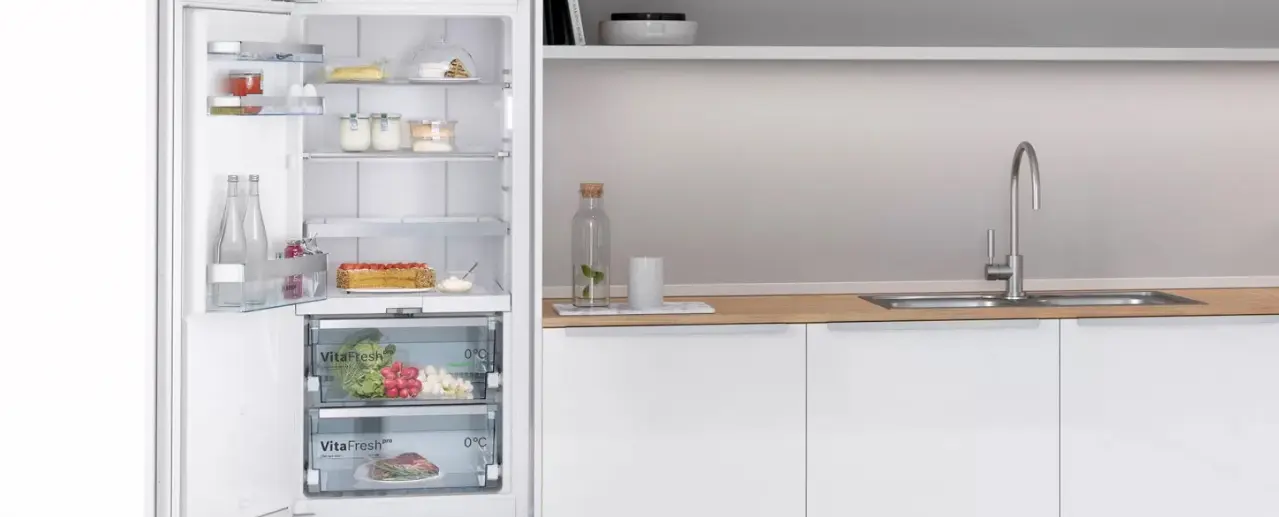
Where should you store different foods in your fridge?
It depends on the type of food:
Top shelf: Jars, cans, and soft drinks (if there is no dedicated drinks rack).
Middle shelf: Soft drinks (if the drinks rack is located here), cheese, spreads, leftovers, and eggs.
Middle/bottom shelf: Meat, cold cuts, and fish.
Bottom: Fruits and vegetables.
In the fridge door, store butter and margarine at the top. Below that, keep sauces and plant-based dairy products, with juices in the bottle rack at the bottom.
What should you do if your fridge is too warm or too cold?
Adjust the temperature up or down. That's the most obvious solution. But what if you've already done that and the temperature remains too high or too low? There may be another issue.
Fridge is too warm
A fridge can become too warm for several reasons:
The door isn't closing properly
Warm air from outside can enter and raise the temperature inside. The door seals may be worn out and need replacing.
Not enough ventilation
A fridge runs day and night, so proper ventilation is essential. If there isn't enough ventilation space, the heat generated by continuous operation cannot escape properly. Check the user manual for more information.
Too much warm food
Don't put a large amount of warm food in the fridge at once. This temporarily raises the temperature, forcing the fridge to work harder to cool down again and using unnecessary extra energy.
High room temperature
Make sure your fridge is not exposed to direct sunlight or placed close to a heat source such as an oven.
Fridge is too cold
A fridge can become too cold for several reasons:
Opening and closing the door frequently
Frequently opening and closing the fridge door can cause the temperature to fluctuate.
Low room temperature
Make sure your fridge is not located in a cold, damp environment such as a shed or unheated storage area.
A fridge that is too warm or too cold can also indicate a technical problem. If that's the case, contact the supplier. If you purchased your fridge from us, it comes with a 5-year warranty, so there is a good chance you won't have to pay anything extra. We'll take care of it for you.
Other fridge problems?
Is your fridge making a strange noise? That doesn't necessarily mean something is broken. Find out what could be causing it. Does your fridge smell bad or is there a layer of water inside? In that case, you may need to clean the drain hole.
How much electricity does a fridge use?
The colder you set your fridge, the more electricity it uses. It's difficult to say exactly how much energy one additional degree of cooling costs per year. This depends on several factors, including the fridge's age, location, energy label, and electricity price.
To give you an idea of energy consumption: according to Milieu Centraal, a new fridge-freezer combination with energy label B uses an average of 130 kWh of electricity per year. A new fridge-freezer combination with energy label E uses an average of 250 kWh per year.
An energy-efficient fridge is often more expensive to purchase, but its lower energy consumption can make it more cost-effective over time. That's why you should always check the energy label before buying a new fridge.
How much you can save with a more energy-efficient fridge depends on the energy consumption of your current fridge and the model you replace it with. Milieu Centraal provides an example calculation on its website.
The right temperature for your freezer
The ideal freezer temperature is -18°C. This helps food stay good for longer. There is no need to set your freezer to a lower temperature. Every degree below -18°C increases energy consumption. For most foods, it also does not provide any noticeable benefit.
Smarter cooling and freezing with Bosch
Our fridges feature several functions designed to help you use energy efficiently and keep food fresh for longer.
SuperCooling
SuperCooling quickly brings newly purchased groceries back down to the right temperature.
SuperFreezing
SuperFreezing does the same thing for your freezer. It freezes newly added food extra quickly while keeping the food that is already frozen at a stable temperature. On some freezers, this function switches on automatically.
VitaFresh
VitaFresh helps keep fruits, vegetables, fish, and meat fresh for longer. The features vary depending on the VitaFresh system. With VitaFresh, your groceries stay fresh for longer, so you don't have to throw away food as quickly.
VitaFresh Pro
VitaFresh Pro helps keep your groceries fresh for longer. You can adjust the temperature and humidity for each drawer yourself. This allows you to store meat and fish at around 0°C while keeping fruits and vegetables crisp and fresh for longer. VitaFresh Pro is available in selected Series 8 fridges.
VitaFresh Plus
VitaFresh Plus helps keep your groceries fresh for up to twice as long. The extra-cold drawer is ideal for meat and fish, while the drawer with higher humidity helps keep fruits and vegetables crisp for longer. VitaFresh Plus is available in selected Series 6 fridges.
VitaFresh
VitaFresh helps keep your groceries fresh for longer. You can adjust the humidity yourself for fruits and vegetables. VitaFresh is available in selected Series 4 and Series 6 fridges.
| VitaFresh Pro | VitaFresh Plus | VitaFresh | |
|---|---|---|---|
| Temperature | 1°C to +3°C | Around 0°C | Around 0°C |
| Fruit & vegetable drawer | 3 humidity settings | 2 humidity settings | 2 humidity settings |
| Fish & meat drawer | A spacious drawer with a dry zone | 2 removable drawers | 2 removable drawers |
Home Connect
With Home Connect, you can get more out of your fridge and freezer. Save energy with Eco Mode, or turn on Vacation Mode in the app when you're away from home for an extended period. You can receive notifications in the app if the fridge door has been left open for too long. You can also set reminders for products that are approaching their expiration date or get recipe suggestions based on what's in your fridge or freezer.
FAQ Bosch fridges
Our fridges
Looking to buy a refrigerator on installments? Check out our range of Bosch fridges.